
FD-Backed Secured Credit Cards in India: The Complete 2026 Guide

Introduction
If you have ever been rejected for a credit card because you have “no credit history” or a thin CIBIL file, you have probably run into one of the most frustrating catch-22s in personal finance: you need credit to build credit, but nobody will give you credit until you already have some. A fixed deposit (FD) backed secured credit card is the most practical way out of that trap, and it is one of the most underused financial tools available to Indian consumers today.
In this guide, we will break down exactly how FD-backed credit cards work, who they are best suited for, how issuers set your credit limit, the hidden fees you should watch for, and a step-by-step process to apply for one. If you are a student, a first-time earner, a freelancer without payslips, or someone rebuilding credit after a rough patch, this article is written specifically for you.
What Is an FD-Backed (Secured) Credit Card?
An FD-backed credit card, also called a secured credit card, is a credit card that is issued against a fixed deposit you hold with the same bank or NBFC. Instead of assessing your income, employment history, or existing CIBIL score, the lender simply blocks a lien on your FD as collateral. If you ever default on your credit card bill, the bank has the legal right to recover the outstanding amount from your FD.
Because the bank’s risk is virtually eliminated, secured credit cards are approved far more easily than unsecured cards — often within a few days, sometimes instantly if you already bank with the issuer. Compare this with unsecured credit cards, where approval depends heavily on income proof, employment stability, and an existing CIBIL score of 700 or higher.
How Do FD-Backed Credit Cards Work?
- You open a fixed deposit with the issuing bank, typically ranging from ₹10,000 to ₹5,00,000 depending on the issuer’s minimum requirement.
- The bank places a lien on the FD, meaning you cannot break or withdraw it while the card is active.
- A credit limit is set, usually between 70% and 100% of your FD value.
- You use the card normally — swiping, online payments, EMI conversions — exactly like any other credit card.
- Your FD continues to earn interest at the applicable fixed deposit rate, so your money isn’t sitting idle.
- Your repayment behavior is reported to credit bureaus every month, which is what actually builds your credit file over time.
The single biggest misconception people have is that a secured card is a “lesser” product. In reality, most FD-backed cards today come with reward points, cashback, airport lounge access, fuel surcharge waivers, and other perks that rival mid-tier unsecured cards — the only real difference is how the credit limit is determined.
Who Should Get an FD-Backed Credit Card?
- Students and first jobbers with no income proof or credit history
- Freelancers and gig workers who cannot show consistent salary slips
- NRIs returning to India who need to rebuild a domestic credit file
- Homemakers without an independent income source
- Anyone recovering from a low or damaged [CIBIL score](internal:loan-credit-card-with-low-cibil-score) after missed payments or a loan default
- People who simply want a guaranteed approval without the uncertainty of a hard credit check
Top Categories of FD-Backed Credit Cards in India (2026)
Rather than recommend specific card names that change their terms frequently, here is how to evaluate the categories available in the market:
Public sector bank secured cards — Usually have the lowest joining fees, sometimes zero, and are ideal if you already hold a savings account with the bank. Processing tends to be slower but reliable.
Private bank secured cards — Faster digital onboarding, better reward structures, and often allow you to apply entirely online if you already have an FD or open one digitally during the application.
NBFC and fintech secured cards — Increasingly popular among younger users, these often report to all four bureaus and are designed specifically as “credit builder” products, sometimes with smaller minimum FD requirements starting around ₹5,000–₹10,000.
Apply for ZET SBM FD Backed Card 👉 Click to Apply
Deposit ₹2,000 in an FD — your money stays yours and earns up to 7% interest.
You get a lifetime free ZET Credit Card and build your credit score to 750+.
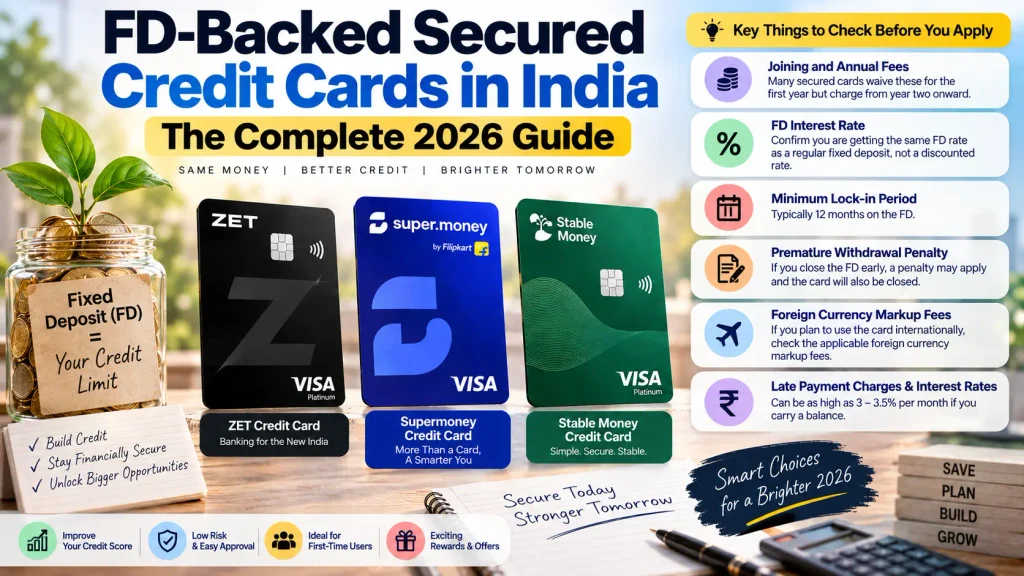
Fees and Charges to Watch For
Even though secured cards are marketed as “no-risk,” they are not always free. Before applying, check for:
- Joining and annual fees — many secured cards waive these for the first year but charge from year two onward
- FD interest rate — confirm you are getting the same FD rate as a regular fixed deposit, not a discounted rate
- Minimum lock-in period on the FD, typically 12 months
- Premature withdrawal penalty if you close the FD early (this also closes the card)
- Foreign currency markup fees if you plan to use the card internationally
- Late payment charges and interest rates, which can be as high as 3–3.5% per month if you carry a balance
FD-Backed Card vs Add-On Card vs Prepaid Card
A common point of confusion is how secured cards differ from prepaid cards or add-on cards. A prepaid card only lets you spend money you have already loaded — it does not build credit history because there is no borrowing or repayment cycle to report. An add-on card is issued under someone else’s primary account and builds credit history for the primary holder, not necessarily for you in the same way. An FD-backed card, by contrast, is a genuine credit product in your own name, with its own billing cycle, minimum due date, and — most importantly — its own credit bureau reporting.
Apply for Stable Money Branded Suryoday Small Finance Bank’s FD Backed Card 👉 Click to Apply
It’s a Lifetime Free UPI card with 8 free lounge visits and 0 annual fees.
FD keeps earning up to 8.1% returns, and I still get 0.5% cashback on every single spend.
And here’s the best part — spend just ₹1,000 on your new card and get ₹250 back.
How an FD-Backed Card Builds Your CIBIL Score
Every month, the issuer reports your outstanding balance, credit limit, and payment status to CIBIL, Experian, Equifax, and CRIF High Mark. Two factors matter most for your score:
- Payment history (35% weight) — Paying your bill in full and on time, every single month, is the single biggest driver of your score.
- [Credit utilization ratio](internal:credit-utilization-ratio-cibil-score) — Keeping your spending below 30% of your credit limit signals responsible usage rather than dependency on credit.
Most users who consistently pay on time see meaningful score movement within six to nine months, and many secured card issuers proactively review your account after 9–12 months to offer an upgrade to an unsecured card with an increased limit and the FD lien released.
Step-by-Step: How to Apply for an FD-Backed Credit Card
- Choose a bank or NBFC where you already have or are willing to open a savings account
- Compare minimum FD requirements, annual fees, and reward structures across at least three issuers
- Open the fixed deposit either in-branch or via net banking/app
- Fill out the secured credit card application form, linking it to your FD
- Complete video KYC or in-branch KYC verification
- Receive your card, typically within 3–10 working days
- Activate the card and set up UPI/auto-debit for bill payments to avoid missing due dates
Apply for SuperMoney Braned Utkarsh Small FInance Bank FD Backed Card 👉 Click to Apply
Their card gives 1% cashback on your spends. Free money lol 🙂
Just apply through the link and get this lifetime free credit card.
It has a 100% approval rate and builds your credit score as well!
Common Mistakes to Avoid
- Applying to too many issuers at once — each hard inquiry can temporarily dent your score, so shortlist one or two before applying
- Maxing out your limit — spending close to 100% of your credit limit every month works against you even if you pay it off
- Missing the due date “by a day” — most issuers report to bureaus based on the statement cycle, and even a short delay can be logged as a late payment
- Forgetting about the FD lock-in — breaking the FD early usually means the card is cancelled instantly
- Ignoring the fine print on fee waivers that expire after the first year
A Realistic Example: Priya’s First Year With a Secured Card
Consider a common scenario. Priya, a 22-year-old graduate on her first job, applies for three unsecured cards and is rejected by all three because she has no credit history — a classic “NA/NH” file. Frustrated, she opens a ₹25,000 fixed deposit with her salary bank and gets an FD-backed card with a ₹20,000 limit approved within four days.
For the next twelve months, she uses the card for recurring expenses — her phone bill, groceries, and a streaming subscription — keeping her spending consistently under ₹5,000, or roughly 25% of her limit. She sets up auto-debit so she never misses a due date. By month nine, her bank proactively reaches out with an offer: an unsecured card with a ₹75,000 limit, no FD required. She accepts, and her original FD — still earning its full interest the entire time — is released without any penalty.
This is not an unusual outcome; it is the standard, designed pathway that most secured card issuers build their products around. The card was never the end goal — it was the credit file it quietly built in the background.
FD-Backed Cards vs Credit-Builder Loans
Some NBFCs offer an alternative credit-building product: a small “credit-builder loan,” where you borrow a modest amount that sits in a locked account while you repay it in installments, with the repayment reported to bureaus. This works on a similar principle to a secured card but lacks the flexibility of ongoing spend-and-repay. For most people, an FD-backed card is the more practical choice because it doubles as an everyday payment tool while it builds your file, rather than being a purely mechanical credit-building exercise.
How Issuers Decide Your Credit Limit
While the general rule of thumb is 70–100% of your FD value, some issuers apply additional considerations even for secured cards, such as:
- FD tenure — a longer-tenure FD may unlock a marginally higher percentage-based limit
- Relationship banking discount — existing savings account holders with a long relationship sometimes get preferential limit ratios
- Card variant — a premium secured card variant (with better rewards) may require a slightly higher minimum FD than the entry-level variant from the same issuer
It is worth asking your relationship manager or checking the issuer’s website for the exact ratio before opening the FD, since a small difference in this percentage can meaningfully affect your available spending power.
What Happens When the FD Matures?
Since most FDs are opened for a 12-month tenure or longer, it’s important to plan for maturity. You generally have three options: renew the FD (and continue the card as-is), let it mature and request an unsecured conversion if your payment history qualifies, or close the FD and card together if you no longer need the product. Always check your issuer’s specific renewal notice period — some auto-renew unless you opt out, while others require an active renewal request before the maturity date.
Apply for ZET SBM FD Backed Card 👉 Click to Apply
Deposit ₹2,000 in an FD — your money stays yours and earns up to 7% interest.
You get a lifetime free ZET Credit Card and build your credit score to 750+.
Frequently Asked Questions
Does an FD-backed card charge me interest on my own money?
No. Interest is only charged if you carry forward an outstanding balance past your due date, exactly like a regular credit card. Your FD continues earning its own separate interest throughout.
Can I upgrade to an unsecured card later?
Yes. Most banks review secured card accounts after 9–12 months of consistent, on-time repayment and may proactively offer an unsecured upgrade.
Is the credit limit always equal to my FD amount?
Not always — most issuers set the limit between 70% and 100% of the FD value, so confirm this before opening the deposit.
What happens if I don’t pay my bill?
The bank can adjust the outstanding amount against your FD and close the card, and the default will still be reported to credit bureaus.
Final Thoughts
An FD-backed secured credit card is not a consolation prize — it is a legitimate, low-risk on-ramp into India’s credit system. Used responsibly for even a year, it can be the single most efficient tool for building the kind of strong CIBIL score that eventually gets you approved for premium unsecured cards, lower-interest personal loans, and better terms on every future credit product you apply for.
For official guidelines on secured lending and credit card regulations, refer to the Reserve Bank of India’s Master Directions on credit card issuance at rbi.org.in, and check your credit report periodically at cibil.com.


One Comment
Comments are closed.